|
|
Elizabeth Goodman {
//
ITP 2001 - 2002 // Interfaces |
|
One Dimension, Two Dimension, Three Dimension, DOOR:
Seeing Through the Invisibles' Art
|
|
Borderline insane yet compulsively readable, the comic series
The Invisibles spanned half of a decade. From September
1994 to January 2000, every month saw another installment
in Grant Morrison's chronicle of the apocalyptic battle between
good (rock 'n' roll, anarchy, and free love) and evil (mechanistic,poorly
dressed, oppressive white guys). Morrison got his start in
comics as a writer of superhero tales, and The Invisibles
functions in part as a comment on the tradition of teams of
heroes who protect mankind against the forces of evil. Morrison
also went a bit... off... in 1994, claiming that he suffered
an alien abduction cum divine intervention. The Invisibles
is thus also his sermon on the mount (I mean it this time),
after experiencing the inconceivably Other - aka God.
Morrison's multiple obsessions with the monstrous, the invisible,
the mass-marketed, and the deviant resonate eerily with other
texts of the time - in particular, Judith Halberstam and Ira
Livingston's introduction to Posthuman Bodies. Published
in 1995, the introduction lays out a framework for investigation
of the "posthuman body." As Halberstam and Livingston (henceforth
referred to as "H/L") write, "The posthuman body is a technology,
a screen, a projected image; it is a body under the sign of
AIDS, a contaminated body, a deadly body, a techno-body; it
is, as we shall see, a queer body. The human body itself is
no longer part of 'the family of man' but of a zoo of posthumanities."
Morrison's six-year trip at the end of the world rewrites
the superhero narrative into a kind of posthuman body: self-conscious,
incoherent, fundamentally... flawed. It's a road full of plotholes;
a screen upon which multiple movies play at the same time.
A zoo with no cages. An autobiographical fiction. A girl who
may or may not have a surprise hidden under the skirt.
Scott McCloud, another comic book artist with a mission,
has another word for the comics: the invisible art. HIS 1992
sermon, Understanding Comics, tries to explain what
happens in the gap between one panel and the next. The trip
from his invisibles to The Invisibles is shorter than
you might think.
Shall we begin?
|
 |
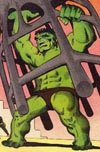
| above: Superman, the Incredible Hulk,
a character from the Watchmen |
|
Part I: Previously in Superhero-land!
Comics, born out of illustrated serial novels in the last
part of the nineteenth century, were not originally for children
-- nor did they feature superheroes. Instead, they were thrilling
tales of crime, horror, and romance. Superhero comics developed
later with the rising international tensions of the 1930s,
and flourished in the WWII years, with Captain America, Superman,
and Wonder Woman all fighting the good fight against the Axis
of Evil. Today, comics fans call this period (without a trace
of irony) the "Golden Age."
Golden Age superheroes were indestructible defenders of
an innocent and defenseless society under constant attack
from enemies without (the Axis Powers) and within (criminals).
Often from another planet, like Superman or Wonder Woman,
they were the interplanetary version of the Allied Powers
-- foreigners who rushed to the aid of the beleagered and
defenseless. Of course, they courteously hid their "secret"
identities under a cloak of reassuring normalcy. Or rather
-- they hid their secret identities under a suit and tie of
reassuring normalcy, and revealed themselves through the flamboyant
cloak of the superhero. The irony, of course, is that the
hidden identity was always better known than the public: Superman
is far more famous and well-loved than Clark Kent. But whatever
costume he wore, Superman was always... a super man. And the
nebbishy glasses were always just the flimsiest of covers
for the perfection of his physique. As the Man of Steel, he
and his powers were conjoined in his body. He could no more
quit fighting evil than he could step out of his skin.
The Silver Age of comics in the 1960s portrayed changing
bodies in a changing world. Comics readers were growing up;
comics aimed at 8-year-olds in the 1950s were aimed at 13-year-olds
in the 1960s. What else is the Incredible Hulk but a metaphor
for the body grown monstrous under the sway of emotions it
cannot control? In 1963, Marvel Comics introduced Spiderman,
the character who would define the Silver Age. Peter Parker,
unlike Clark Kent, was a real nerd. As a short, nerdy high
schooler, he was bitten by a radioactive (!) spider, and developed
super powers and a super mission to fight crime. Unlike Superman,
he didn't start out life as a superhero. Rather, his life
-- and his body -- were forever changed by his involvement
with the new technologies born from the Bomb. This same involvement
with technology is what enables him to turn his disastrous
misadventure into a mission: his costume is not just a costume
-- it is a prosthetic organ that enables him to spin webs,
to truly BE Spiderman. Like his mutant companions the "uncanny"
X-Men, Spiderman's flawed, infected, evolving body is aeons
away from the ageless perfection of the Golden Age.
There is no clever name for the new age of superhero comics
that followed the Silver Age. Post-Watergate, in the midst
of the AIDS epidemic, the uncorrupted body politic protected
by saintly leaders seemed quaintly naive, and the infected
superhero an oxymoron. British writer Alan Moore's epic Watchmen
series resurrected the superhero story as a cautionary tale:
if the superheroes are the watchmen of our liberties, "who
will watch the watchmen?" Who will save us from the superpowers
and their terrifying nuclear weapons? The superheroes of the
Golden Age had reached their middle age, and Vietnam had broken
their certainties.
Meanwhile, an small company called (appropriately enough)
Image Comics had made a name for itself by taking the traditional
body beautiful of the superhero to the next level: the body
extreme. Their superheroes were almost parodically muscular,
the violence almost Mannerist in its grostesquerie. Imagine
"Rambo," but with lots of hot chicks in bikinis. Marvel had
gone bankrupt in 1986; clearly the superhero genre did not
satisfy its readers as it had in the past.
Which was the superhero state of affairs in 1992, two years
before Grant Morrison started writing The Invisibles.
Morrison, extremely successful as a writer of traditional
superhero comics, had decided to take a break from his craft.
That's why he was in Nepal when the aliens revealed the meaning
of the universe.
|
|
Part II: Under the Bridge
In 1992, comic creator Scott McCloud also decided to take
a break from writing a monthly series. The book that emerged
from his break, Understanding Comics: The Invisible Art,
is an attempt to take the funny pages very, very seriously.
A structuralist at heart, McCloud asks his readers to "do
a little AESTHETIC SURGERY and separate FORM from CONTENT."
(5) His goal: an examination of the structures underlying
comics as a sequential artform, not just an amusement for
children. Comics, as McCloud describes them, are an essentially
cyborg art: a hybrid of words plus pictures plus the empty
space in between. Plus the "invisible." Like cinema, comics
are time-based. But unlike film, time in the comics is composited
into the graphic unity we call the page. You READ the moments
-- or the panels -- one after the other, but you SEE them
all at once on the page. To move from one panel to another,
readers must bridge the gap with their own explanations.
The invisible art of the comics, McCloud suggests, is in
how time -- and meaning -- flow under that bridge.
|
 |
 |
above: Lord Fanny and King Mob discuss
the brave new world of the new millennium.
below: "A bullet at the right time..." |
|
Part III: Pop Tarts, Pop Secrets, Pop Guns
Morrison loves superhero comic books, and his genius lies
in his recognition that the eidolon of the superstar is only
infintesimally distant from the eidolon of the superhero.
And the superhero, as we know from myth, is just the bastard
child of the divine. Given the pervasiveness of celebrity
culture and the cheapness of mass market style, he suggests
that anyone could really become... Anyone. Or Anyones.
Morrison's characters are not traditional superheroes. They're
people who have decided to become superheroes, and now live
with the consequences of their choice: a vision of existence
as an endless battle between freedom and tyranny, a sense
that the fate of the world depends upon them, and truly groovy
wardrobes with unlimited time for costume changes.
It's superheroics as a product of late capitalist consumer
culture.
The Invisibles explicitly links the desire to be a
superhero with the imagery of popular culture. Car ads, spy
movies, cheap thrillers, action flicks -- the Invisibles ride
genres like cars, then trade them in for a newer model.
It's no accident that the "magic word" of the final, climactic
battle is "POP." That's what you do to nightmares of the new;
that's what you do to word-bubbles; that's what you do to
outmoded values and artforms: you make them all go Pop. And
what comes next, for Morrison, is scary and funny and sickening
all at once -- like plastic babies in a blender.
Truthfully, The Invisibles is only sort of a superhero
story. It's about WANTING to be a superhero, with a superbody
and superwardrobe and a supersexlife -- and the hows and whys
of that desire. It's about what wanting to be a superhero
does to people, and for people. And what the wanting implies
about the way we see ourselves, and our world.
But the secret pleasure of The Invisibles is the
way it suggests that if we just give up the desire to be grossly
famous for 15 minutes we can all be invisible superheroes
for as long as we want. "Style terror," Morrison advises in
one issue. "Dress to kill."
In his final ecstatic vision of a post-apocalyptic world,
he imagines a world in which we are all superheroes, all celebrities:
"Drum machine in the trainers, man: 'No more popstars, no
more fucking DJs, just kids dancing themselves deaf until
dawn.'"
|
 |
| above: click on the graphic to see the
full page, with analysis |
|
Part IV: Et in Academia Ego...
Whilst the Invisibles were tripping balls and summoning Mayan
deities, Judith Halberstam and Ira Livingston wrote an introduction
to their 1995 anthology Posthuman Bodies that resonates
with many of Morrison's concerns: speed, time, pop culture,
and the posthuman. Not to mention deviancy in all its fun
flavors.
We begin with speed, first: the velocity of the new in a
culture whose history, mediated through technology, draws
ever closer to the moment of the present. The speed of that
new, splitting present into future and past the way scientists
can split an atom, creates a crisis of narrative, and thus
a crisis of lived time from which is born the posthuman. Halberstam
and Livingston (H/L) write,
"Posthuman bodies do not belong to linear history. They
are of the past and future lived as present crisis. This
present, this crisis, does not glide smoothly along a one-dimensional
timeline but erupts or coalesces non-locally across an only
partially temporizable realm of meaning" (4).
It's easier to imagine what H/L might mean if we think of
McCloud's description of temporality in sequential art. Comics
slice and dice the page into units of time that may or may
not actually be temporally adjacent: the meaning as derived
by the reader emerges in bits and pieces from the spaces between
panels, between seconds, between years. The Invisibles moves
forwards and backwards in time, dramatizing a crisis of history
that from one perspective we see as a monstrous intruder from
another world, and from another -- read years later -- as
a woman careening through space and time, locked in the embrace
of a time machine.
Saving or losing? Woman/machine or monster? H/L query the
use of such distinctions: "It is not that Western Culture
will be saved or lost... it is that laboring under notions
of saving and losing -- turf protection, damage control --
has become more destructive, while the ongoing necessity of
inventing more workable fictions has become more acute" (9).
We could call The Invisibles a "workable fiction,"
imperfect by design, with messy meanings leaking out through
the gutter. Or, as "Boy," says, holding her daughter by the
hand: "I stopped needing to save the world...Saving is what
misers do." Morrison began with an issue titled "Say You Want
a Revolution," and ended the series with a character saying
"No more revolutions! We refuse to even recognize the Wheel!"
Morrison's "workable fiction" infects the seemingly stable
genre of superhero comics with the same bug that has long
plagued prose fiction: the unreliable narrator. Only in this
case, it's the unreliable COSMOLOGY. Even the Watchmen never
really asked whether the fight was EVER worth it. But Morrison
creates a superhero narrative only to explode it five years
later with sentences like: "Superheroes on a corrupt digital
planet, conjured in the mainframes of epic, monstrous A.I.s.
The universe a program inside a Manichaean murder machine."
Ragged Robin loved the "murder machine" so much she wrote
herself into it; his readers followed it for years. His "workable
fiction" turns endless struggle into a chessmatch with players
who have forgotten that it's all just a game. Morrison just
wants to supplant suffering, he writes elsewhere, with play.
|
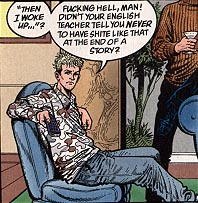 |
| Jack Frost, TV remote in hand, reminds
us that stories are supposed to have exciting conclusions |
|
Part V: Say You Want a What?
From 1994 to 2000, The Invisibles appeared every month
as a 40-page color issue -- with some delays caused by production
difficulties and Morrison's second near-death experience.
Every issue ends, as is conventional, on a cliff-hanger, butThe
Invisibles as a whole contains four major story cycles
each with its own structure of conflict and (partial) resolution,
and its own locale.
Morrison's cosmology is dense; his mythology roughly patchworked.
But the experience of reading comics isn't quite like reading
a novel. The original readers spent five years with the story,
and waited weeks for the resolution of each climax. While
we cannot -- nor should we try to -- recreate the "original"
experience, it seems worthwhile to go through the major plot
points to give some idea of the breadth of the action. Forthwith,
a whirlwind tour through the world of the Invisibles. I'll
try to make this as painless as possible.
The Invisibles are a loosely-linked confederation of anarchist
secret agents fighting a SEEMINGLY unending battle against
the demonic forces of the Outside Church. We follow the adventures
of:
King Mob -- once a British horror writer, now a
fashionable TERRORIST
Ragged Robin -- a time-travelling Tarot-reader who's
only occasionally INSANE
Lord Fanny -- a TRANSVESTITE Brazilian witch
Jack Frost -- the designated LUKE SKYWALKER
Boy -- an American ex-cop, or maybe an ex-Black Panther,
or maybe a TRIPLE AGENT for the Other Side
Plus: a neurotic billionaire, a sexy nonagerian, a homeless
madman, and the all-to-fleshy ghost of the Marquis de Sade.
As presented in the first years of the series, the plot
is a millenial countdown: according to King Mob, the universe
is "a HOLOGRAM created by the overlapping of two meta-universes"
-- one healthy, one sick. Reality is just an optical illusion.
The Invisibles inhabit the boundary between the healthy meta-universe
and our universe; the Outside Church lies on the boundary
of the sick. The two universes are collapsing, and the Invisibles
represent an attempt by the healthy universe (which is represented
in our universe by a giant satellite called Barbelith) to
prevent the sick universe from infecting and destroying our
own through an anti-Christ-like figure called the Moonchild.
As one Invisible puts it: "You may think the universe is sick...
But we rather think we've found a way to inoculate." Invisibility
for Morrison is a means to power, not an attribute of powerlessness.
Being invisible is one way to escape the PANOPTICON.
The enemies that the Invisibles fight are both the incursions
of the sick universe -- the Archons -- and their pawns in
this universe, who do awful things like castrate small boys
in England, use crack to turn American black men into zombies,
and abuse innocent space aliens in Brazil. The representatives
of the Outside Church, aka the Forgotten Ones, are represented
through both BIOLOGICAL and MECHANISTIC metaphors of domination
and contamination:
"Before our very eyes, our reality.... our entire frame
of reference had become the breeding ground for kind of
BACTERIAL civilization... A machine race of meaningless,
ruthless EFFICIENCY... endless ghettoes... atrocity camps...
an empire of psychic ARMY ANTS, eating its way throught
the very FOUNDATION of things."
If the Outside Church represents the forces of sterility,
conformity, and stasis, the Invisibles represent the opposite:
sexuality in all its forms, DEVIANCY, and continual change.
Morrison most often EMBODIES those concepts in Fanny, who
(as written) is born a boy, raised a girl, and chooses to
be either, or both, depending. Fanny's power resides in the
rejection of divisions between male and female; life and death;
"good" and "evil." The gods of the Maya, as manifested through
Fanny, are as TERRIFYING as the monsters Fanny battles; like
the voudoun gods invoked by the African-American Invisibles
Papa Skat and Jim Crow, they demand their own blood sacrifices.
And over the five years of the series, Fanny repeatedly neutralizes
threats by uniting herself/himself with them. It seems a little
PARADOXICAL, doesn't it, that a text built around eternal
opposition would repeatedly suggest not just that "good" can
resemble "evil," but also that the "good" side involves the
rejection of essential and permanent divisions?
|
 |
|
Somewhere around 1998, Morrison begins to introduce another
image of the universe: it is an embodied, "larval," organism,
not a holographic image. And we, who live within that universe,
are represented as "time maggots," leaving trails of past
selves behind us like the human motion captured in" Nude
Descending a Staircase." The Manichaean war presented
earlier is for Morrison the SYMPTOM, not the problem. The
universe, as more than one character explains at length, is
a larval consciousness growing to self-awareness as the SUPERCONTEXT:
network as godhead. Humans are the means through which the
universe matures, and the Outside Church and the Invisibles
themselves are just two representations of growing pains.
Or, as a character named Mr. Six puts it (in an issue titled,
"Half a dozen of the Other," no less): "Larval consciousness
experiences the introduction of necessary inoculating agents
from the Supercontext as a form of invasion by hostile, bacterial
forces. The inoculation is conceptualized by the developing
larva as an invasion of threatening 'not-self' material."
Or, as Jacques Derrida writes (as quoted by H/L): "the as
yet unnameable which is proclaiming itself and which can do
so, as is necessary whenever a birth is in the offing, only
under the species of the non-species, in the formless, mute,
infant and terrifying form of MONSTROSITY" (PB 3).
As H/L explain, "Posthuman monstrosity and its bodily forms
are recognizable because they occupy the overlap between the
now and the then... the annunciation of posthumanity is always
both premature and old news." Strangely enough, there IS a
"formless, mute, infant and terrifying form of monstrosity"
in The Invisibles: it is the Moonchild, the bastard
offspring of British royalty and demonic Other, who emerges,
like a horrifying Alice, from a MIRROR to eat human flesh.
The Moonchild, we are told, lives in the future as dominated
by the Outside Church -- but of course, as it emerges from
a mirror, we can also read it as the ghastly future posthuman
we cannot accommodate but which is already here. Or, as Jack
Frost says, "Remember it's all just a MIRROR we made to SEE
ourselves in."
The OUTSIDE Church, then, represents what H/L might call
"the speed of the new...colliding with the fast approaching
past" (3). Monsters of the Church -- called the FORGOTTEN
Ones or the Archons -- are repeatedly pictured as breaking
through walls, or walking through mirrors. Crucially, however,
the most vivid pictures of a world dominated by the Forgotten
Ones come from the minds of human characters. Boy has drug-induced
fantasies of Dis, a Dali-esque hell world; Jack Frost goes
on a tour of a potential future with a mysterious character
called the Blind Chessplayer. These DIS-topic visions are
never contained within panels; they spill across spreads and
bleed -- literally -- off the edges of the page. As such,
they dominate the frame of reference, quite literally invading
the entire page just as the terrifying visions of the Archons
spill over and invade the our universe.
Morrison's mysterious figure of enlightenment is The Blind
Chessplayer. Supposedly unable to see, he is immune to the
glittery allure of the Invisibles and the repulsive nightmare
of the Archons. Or one might say: to him, everything is INVISIBLE.
It's the familiar PARADOX: blinded, he sees so much more.
"In my mind's eye, a DIFFERENT great conflict plays out
each time. The international workers' struggle against capitalist
exploitation. The EVOLUTIONARY drive versus the fear of
CHANGE. CONTAMINANTS warring with ANTIBODIES. Or HERE, on
one side, the dreadful guardians of the BLACK IRON PRISON,
condensing their macro-geometry into these protomaterial
JIGSAW forms; the great KING-ARCHONS of this eon.... And
here, the SONS OF LIGHT, mustered in radiant battalions.
I don't suppose you know what 'Manichaean' means yet?"
King Mob's theory of the universe as hologram looks a little
different now. The Archons, says the Blind Chessplayer, are
human FEARS, "rising and condensing on the inside surface
of the holographic membrane." The universe we perceived so
clearly in the first years of the series was just a projection
screen for images -- images of glamour, images of evil, images
of eternal war. As Jack Frost attempts to tell King Mob, "If
our words are circles, theirs are BUBBLES." Which is a good
way of saying that human perception inevitably reduces the
richness of the tactile world to flattened concepts. The "Archons"
are named (as Morrison explains in the text) for the Gnostic
conception of the evils of the material world; to think of
the universe as a "hologram," as King Mob does, is to share
that perception. Says Jack Frost, "We're stuck in a thought,
right... We've been thinking it for so long we've forgot...
When you stop thinking it, you see it for what it is... and
you can start thinking better ones." (emphasis mine) The entwined
metaphors of sight and memory suggest that being Invisible
may not be so far from being Forgotten.
These Manichaeans are usually male, and live within the compass
of the Invisibles. Women, however, appear and reappear: Jacqui,
King Mob's ex, lives quietly as a masseuse; Lucille, aka "Boy,"
aka "Michelle," aka "Venus" simply quits. We see her years
later with a small child. KM's life is saved in the fifth
year by the unsuspecting widow of a man he killed in the first.
The recurring narrative motif of nurturing women who leave
and return to reproach King Mob (who, it must be said, looks
like a much idealized version of the author) suggests that
one of the fulcrums of the plot is the usual matrix of heterosexuality:
men enjoy killing things with weapons or with words, while
women take care of people. In the end, Ragged Robin, who left
King Mob 12 years earlier to go back to their future, returns
to him from her trip through time clad in the typical scanty
comic-babe outfit. She flings her arms around him and says
something about "baby in a dream" -- but mostly she's returning
to him, to stay. He deserves her, by his lights: he's a "grownup
now": he uses words, not guns, to change reality.
"Grownup," "maturing," "placenta"-- the language of enlightenment
in The Invisibles is decidedly of the body -- and the
female body at that. The analogy is menstrual: "She went around
for days in a state of TERROR, thinking she'd lost her mind,
thinking she was DYING, bleeding to death. Thinking she was
becoming an ANGEL... All she was doing was GROWING UP but
some things we didn't discuss in polite circles. Imagine something
like that happening to you. Imagine thinking you're going
CRAZY, all alone with it." Madness comes when a symptom of
adulthood -- of life -- is mistaken for the cause of death.
But how was "she" to know, when her very body was an unmentionable?
As H/L write, "Recognition of a posthuman agenda requires
new protocols for reading the positivity of horror and abjection,
not as representational... but as functional dysfunctions
that make other things happen." (14) Hence Morrison's resurrection
of the Marquis de Sade as a kind of mascot: profane, disgusting,
corrupt, his goal is to "destroy taboos, eliminate boundaries...[make]
gold from shit." But if the world of embodiment is the best
we have -- the "only heaven we can TOUCH," as one character
says -- where is the place of language?
Writing, Haraway's original "cyborg" technology, functions
here as a drug-lubricated interface between the body and the
world. As Robin says, "I'm writing a book, I'm floating in
a warm ocean of living words." She writes those words, but
in turn they become her life: the Flesh made Word, and vice
versa. In a state of altered consciousness (which Morrison
and most of his characters seem to habitually occupy), words
can BE the very thing they describe.
Language is the original technology of PROSTHETIC memory,
allowing us to write and rewrite, copy and paste through time.
Morrison writes in the age of word processing; the Hand of
Glory is a "CURSOR," not a pen. It marks the points of insertion
of new narratives into the past... and the erasure of the
old. Jack Frost, the "Buddha," is not a Christ figure but
rather a Baal Shem Tov. His power is derived from his manipulation
of a divine language, not from his sacrificed body. He creates
the cursor from a cast-off glove; it is the characters/readers
who see that glove as an amputated hand. Still, for Morrison,
we cannot separate the body from language: Robin wears a "fiction
suit" to write her life intoThe Invisibles; the Hand
of Glory is just a glove. We animate the technology of writing;
we wear it, and in return can travel, as with the "time suit,"
in more dimensions than just three. As Robin does, we are
"glancing off the edges... intersecting across planes."
In The Invisibles, language is the "binding agent"
(as one character says) of time, McCloud's invisible art.
Words and pictures -- what McCloud calls the invisible and
the visible -- come together in the comics to create the illusion
of continuous narrative from moment to moment. But it's only
illusion. We all know what lies between: the gutters where
the imagination flows. Where the new "coalesces and erupts"
(H/L 4). Or, as Jack Frost says, "That's them: the bits BETWEEN
everything, come to life and showing themselves. Scare the
SHITE out of you for a little bit if you're not ready for
it."
|
 |
| click on above for full page. |
|
|
|