links for 2009-07-03

| | Comments (0) | TrackBacks (0)

links for 2009-07-02

| | Comments (0) | TrackBacks (0)

links for 2009-07-01

| | Comments (0) | TrackBacks (0)

links for 2009-06-30

| | Comments (0) | TrackBacks (0)

Whoops! Forgot to upload this during the conference.
-----------
themes

1) progress / innovation is not always where or what you think it is -- and does not
is it necessary to project yourself into the future? is it necessary to do it? who are you to say what the futures of other people should be?

2) uneven development
tensions, ambiguities and contradicts are constitutive of technologies

3) whether and how children today are different today than we were
going beyond "digital native" rhetoric

4) what kinds of enabling techniques let people be creative in their own ways, over time?

what's new:
children have new developmental challenges to face
1) share-ism: a predilection for sharing before working things out on their own
2) border-crossing: moving between worlds

drawing from Douglas Repetto: stepping back as an educator; being humble; having no fixed idea (about what is a robot)
In contradiction to the discourse of the grand evangelizers, who create environments for other people to design in. This is difficult without acknowledging that you are the god and creator of those environments. Vs making spaces for people to meet to do things they wouldn't otherwise do. Sometimes more like theater. These may be the best holding structures to allow people to be makers themselves, and not just monkeying around environments or having to endorse discourses by "those who know better."

links for 2009-06-20

| | Comments (0) | TrackBacks (0)
  • "Your Backyard Farmer works a lot like any other home contractor. Streeter and Smith visit dozens of yards each week throughout the growing season to plant, maintain and harvest their clients' edible crops. With their help, even plots as small as 10-by-10 feet yield a cornucopia of produce. They also offer monthly lessons where DIY families can learn how to make their own food gardens grow. "

LIFT 09: François Jégou

| | Comments (0) | TrackBacks (0)

Design for social innovations and sustainability

www.solutioning-design.net
www.sustainable-everyday.net

key points of sustainable consumption
- best selling books analyzed and found to have mostly useless tips (Bilharz, Lorek, and Schmitt)

hitchhike solidarity network --> promising sustainability, but it's niche

creative communities for sustainable lifestyles: workshops with design schools in Brazil, China, Africa

agri-tourism
neighborhood library
cooperative grocery stores
"foot-bus": elderly volunteers walk kids to and from school
tools to share kids clothes, tools
tools to ask neighbors to do shopping favors, to cut down on travel
co-housing and eco-villages as tourist opportunities

his point: creative communities aren't waiting for the "creative class" to solve their problems.
they are focused on solving their own problems.
these are small solutions, but they are also small steps that are sustainable because they are based on reciprocity.
moving away from the notion of single genius inventors; this collective small scale innovation.

LIFT 09: Frank Kresin

| | Comments (0) | TrackBacks (0)

(Waag Society)

the democratic paradox: we need radical changes but at the moment only small changes are feasible because of the political system of democracy
change itself must be sustainable
so what will stimulate people to change their behavior?
- efficiency and money
- health and safety
- meaning and fun
- connections and belonging

power mapping
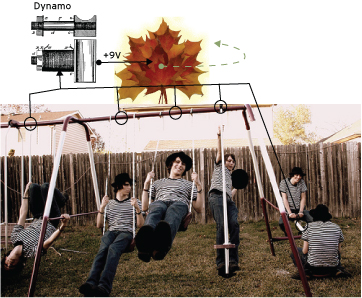
diy microgeneration
like using children's toys and revolving doors to generate energy
qurrent.com: neighborhood energy collective for production and sharing
mapping Amsterdam to find opportunities for wind energy

local fabrication
usb bike power charging
plamp - plant lamp: combination of plant and lamp, getting some of the CO2 back.
personal power plant (on instructables)

urban eco-map, San Francisco (run by Cisco and city government)

Amsterdam Real-Time
so what happens when you combine eco-map with real-time city?
they are making an Amsterdam eco-map with real-time and dynamic info

sensors
inspired by
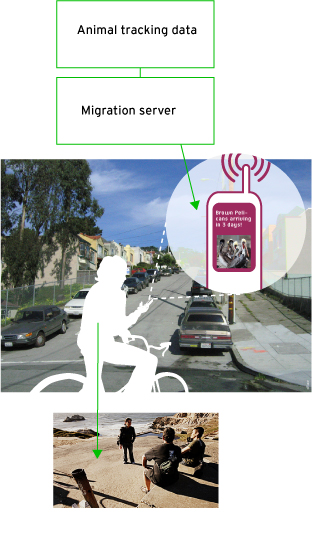
- Beatriz da Costa's Pigeon Blog
- Tad Hirsch's coconut sound pollution measurement installation
- Montre Verte, by Fing: a wearable ozone and pollution monitor that connects to mobile phone to upload data

hurdles
- existing organizations defend their positions
- apparent lack of alternatives for civilians [also, the problem of creating hopelessness]
- measurement problems [this is what Eric Paulos talks about frequently] -- solution is to aggregate lots of measurements
- cost and quality of sensors
- ownership and maintenance

ideas
- inclusive routes to coordinate travel and increase use of public transport systems

I just finished giving this talk at LIFT 09 on "Designing for Urban Green Spaces." It's close to the Etech talk, but has some new thoughts at the end.

links for 2009-06-19

| | Comments (0) | TrackBacks (0)
  • "It is crucial to analyse cities holistically as ensembles of technologies, infrastructures, buildings, institutions and the actors who design, manage and inhabit them as no single discipline can effectively tackle the enormous challenges cities currently face. The emerging field of socio-technical studies of architecture and urbanism is well equipped for such a task. However, as Moore and Karvonen observe, "there has been little emphasis in STS scholarship to date on the design of the built environment" (2008, 29). This workshop provides much-needed coordination between scholars in this field and an opportunity to develop an active research strategy that avoids redundancies and identifies potentials for synergies and future collaborations."

    5-6 November, Maastricht


  • New blog, more focused on sites than people and systems:

    "Veg.itecture is a spin-off site from Landscape+Urbanism, focusing on the representation and implementation of green roofs, living walls, and vertical farming from around the world."


  • official website for the Green Engines workshop in Barcelona this summer


  • Ecosistemaurbano reports on a summer workshop in Barcelona with the evocative title of "green engines":

    "Urban parks can be the future green engines of a self-sufficient urban environment. A productive landscape merges nature for pleasant city escape, with a resource-efficient milieu. The implementation of sustainable ecosystems of community self-organization into new strategic planning, integrates community supported urban farming, with the production of renewable energies, water purification and waste management. This productive landscape strengthens personal and community responsibility, it is a platform for individual creativity, and social organization. The workshop searches how urban and landscape design may establish the main catalyst strategies for the generation of a self-sustained green space. ... The workshop evaluates how a community self-organized productive landscape can embrace existing historical sites, bringing into dialogue different landscape design approaches."


    (tags: urban green parks)

LIFT 09: Douglas Repetto

| | Comments (0) | TrackBacks (0)

nerds [!]
everyday creativity is not just "there"
nerdom: "being deeply invested in something"

a celebration of nerds
- like the knitting nerd who got a tattoo of a knitting ball
- knitting nerds as the symbol of nerdom
- like knitting nerds who make sweaters from the hair of their pets
- or topology knitting nerds

what about metal nerds?
food nerds

a network of nerds, a web of nerds, a fractal of nerds, a jungle of nerds!
but people are probably not on the extremes of all possible nerd paths
but the decisions seem logical, and even moral

nerd war!
- details are an important thing, sometimes
- but you do need to start somewhere, sometime

coercion
- for many years mixed up with ideas of dirty hippies
- so how do we find ways to negotiate out of the nerd war?

examples of nerd wars, good and bad

[this is essentially an argument about essentialism and the varying importance of extreme positions]

so how do we find platforms for sharing what we care about that do not bring about nerd war?

nerdiversity!
- ex: ArtBots
- ex: dorkbot

LIFT 09: Marcos Garcia

| | Comments (0) | TrackBacks (0)

Interactivos: a platform for collective production and learning

initiative of Media Lab Prado, cultural initiative of Madrid City Council
art, science, technology

two week production workshop, conference, exhibition of workshop products - about 60 attendees
1) international call for tutors (free travel and accommodation)
2) call for collaborators (free travel)

importance of in-person contact and communication

3) sharing documentation on and offline

4) welcoming visitors to the lab with "cultural mediators" who lead tours of the lab

5) improvised activities

6) replicated

LIFT 09: Catherine Fieschi

| | Comments (0) | TrackBacks (0)

Creating Imagined Communities of Belonging
(or How One Institutions Stopped Worrying and Learned to Love Social Innovation)

- large institutions and technology
-- especially from a major British NGO
-- addressing massive collective action problems
-- trying to let go of a need for physical presence, and the beloved patterns that require it
-- dealing with issues of digital divide (though that's a myth: people have mobile phones all over)
-- in changing others, changing oneself
- some projects
-- "skype grannies" in the UK who are recruited to coach youngsters in slums in India
-- Tierra del Fuego: keeping the city council accountable by blogging council meetings

Richard Sennett: three values that are being undermined -- narrative, usefulness, craftsmanship
- so where is the role of the British Council in all that? Supporting it with simple interventions

LIFT 09: Martin Duval

| | Comments (0) | TrackBacks (0)

"social media and crowdsourcing"
"idea management software"

LIFT 09: Euan Semple

| | Comments (0) | TrackBacks (0)

trying to get IT departments to try new things - "come to grips with the change"
vs "the guys who try to sell you data management, enterprise management, and, God help us, knowledge management"
European section of NYK (the Japanese shipping company)
- using small projects to show the benefit of new projects so it can be sold to an IT dept.
IT departments fear what's going on - sneering is symptomatic of pomposity
how much does pomposity cost organizations? how many clever ideas are stifled? how many meetings run on? how many projects get extended too long?
yet that cost is trivial compared to the cost of installing some social tools and accepting some "nattering"
not command and control but still management of the system
[Mike says: "It's the end of modernism and central planning!]


LIFT 09: Timo Arnall

| | Comments (0) | TrackBacks (0)

Designing for an Internet of Things

citing Marc Smith - physical and digital interaction: digital interaction takes place in a different place; we go "into" screens and "to" the Internet
trying to look at how we can participate in digital without being in front of screen
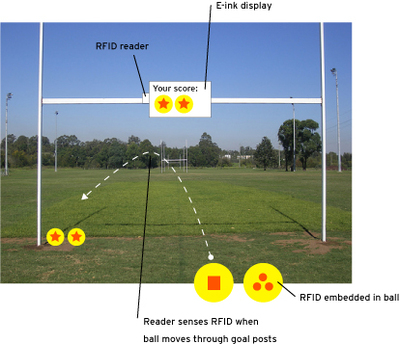
RFID
examples of playful projects from Timo's lab
three levels
- tangible and embodied

[my computer died]

LIFT 09: Usman Haque

| | Comments (0) | TrackBacks (0)

Bemused by idea of "Internet of Things" -- it unites two things he's not interested in: the internet and things
He is more interested in spaces, and environments, and people
talking about Pachube
[he's using the new zoomy presentation tool to give his talk! Will it work? Will it give us motion sickness? Who knows?]
idea of being connected
- we are connected all over, but we still have neighbors -- they're just non-geographical
- DON'T PANIC!
idea of interdependence
- "their environment is that which they construct in their relationship to each other"
idea of participation
- "spime wrangling": actively engaging in production of our environments
"rubbish is the root of virtuosity"
- to make something beautiful with a tool, you must also be able to make crap as well
so, patchube
- "a genearlized realtime broker for networked environments"
- trying to work with small scale projects: enable a simple system for smaller entities to more casually share data
- they do not specify what gets shared; it's
not an internet of things but an ecosystem of environments
- not about rooms that change color when I walk in, not corporate sensor nets, about sharing "the context of my environment" with "the context of your environment"
[I think this is where the terminology gets dodgy. For Haque, the "environment" is co-constructed at the interface between a self and the felt-world.

LIFT 09: Bruce Sterling

| | Comments (0) | TrackBacks (0)

[my comments in brackets]

spimes as theory objects - five years on
a post-industrial system based on things
"a better way to put our toys away, a cleaner more rational system"
unifying 6 big trends
"this is like trying to nail 6 big ice cubes together."

"a spime is a thing which is designed to fit into the Internet of Things"
"been spimed"; it's "spimey"

"when I wrote my book ubicomp was a laboratory idea, now there are some serious real world iniatives"
lists Sun, Microsoft, General Electric, and then smaller companies like Pachube, Nabaztag, ThingM

"make all the plans digital"
" the RFID industry is in trouble."
- American driven
- the "magic word problem" - you have to associate the bars and symbols with an object, a semantic problem - "it's almost artificial intelligence hard"
- "tag clouds were a very sexy idea five years ago, because it seemed like there might be a statistical way to defeat this particular problem"
-- the problem was that sometimes the magic tags go away or vanish. industrial designers are trained to make coherent things: branded, distinct, in a nicely formed shell
-- but what about the components of the thing? then they need words and tags and ids too -- tags and subtags and subsubsubtags. and then there's a serious organizational problem
- example: a physical object designed like a contemporary website "it did not occur to me that in an Internet of Things, things would be become more like Internet structures."
- Internet fabrication: coming on "pretty strong"
- tracking! of people and things...it has a dark side, and it's not dependable
- searching! most search technology is beyond your comprehension, with a smooth interface on top. it's an infrastructure, like sewers, that you won't directly have. Can you Google my underwear?
- recycling: "it's very hard to make people care about trash or look after trash....but if we don't manage our trash better, our civilization is going to collapse"
- the Internet of Things as a series of pipes, in which the physical pipes are contained in the virtual pipes [or was it the other way?]
- [he calls his list of spime characteristics a "stack"]
- "it's not spread all over the world all at once, like a cloud or paint]
- "the victory condition": an Internet of Things that is a "phantom for visionaries," that "we do not see or hear, or talk about" but that lies in the background

[my own commentary is in brackets]

Technosciences and ICT in Society
"Tensions, contradictions, and ambiguities are consitutive of any technology in any society"
[this is a pretty basic, general summary]

in democratic society and technology today
Tension 1: btw logic of innovation and change and existing forms of life and social values (ex: biotech)
Tension 2: btw logic of economic markets and of political democracy (ex: liberalism, private appropriation vs collective)
- corporate innovation vs defense of commons
- we have to wait for new technologies to be implemented to understand their effects
- time delay in reaction to techology
Tension 3: Technologies, markets, and social orders always need to be governed and managed
- complex relationship between individual freedom and collective assessment -- everything needs to be regulated, framed, [designed]
Tension 4: There are always tensions around the many regulations that make any democratic order
- but different orders of technology have different logics, and the regulations and tension are different
- ex: creation of soda industry around Marseille in 1810 - disastrous pollution, followed by experts in consultation. experts torn between obvious devastation and desire to defend French industry and not allow it to fall behind other countries'. And then the battle went to court. But the logic of the court is not that of the expert committee. And the courts forced the companies to install systems to control pollution.

What is New and Not-So-New with ICT and the 'Cognitive Economy'

1. A dematerialized world, open to all, free and ecologically better?
[he quotes Chandra Mukerji! I LOVE Chandra Mukerji's work: The material existence, we do not renounce it when we surf the net. We do not renonce the exigencies of our territorial life -- we have produced a world that is produced by concrete borders which is sufficients guaranteed to forget them. We can forget that we are sensually and bodily consituted.

2. The 'cognitive economy', 'knowledge societies,' and property
- The 'cognitive economy' is also 'a new way to do business and redirect profits' -- but this feeling and logic happened before, in the 18th and 19th century. In 1790, for example, the first establishment of patents. And in the 1980s the rule of patents was transformed. So "now" is important, but there are earlier moments which resemble this one.

3. Usage and bottom-up innovation
- Ascendent innovation is valuable and needs to be defended
- has always been at the core of technological innovation (ex: radio, not made by a big company, invented by users along with companies)
- has always been studied by business to improve products -- we know that

4. [and then he finished very quickly!]

links for 2009-06-15

| | Comments (0) | TrackBacks (0)
  • "On a recent rainy evening in Brooklyn, I was at a friend’s house playing (a bit sheepishly, given my incipient middle age) Call of Duty: World at War. Scrolling through the game’s menus, I noticed a screen for Xbox Live, which allows you to play against remote users via broadband. The number of Call of Duty players online at that moment? More than 66,000.

    Walking home, I ruminated on the number. Sixty-six thousand is the population of a small city — Muncie, Ind., for one. Who and where was this invisible metropolis? What infrastructure was needed to create this city of ether?"


links for 2009-06-12

| | Comments (0) | TrackBacks (0)
  • "Aston Farm in Exmoor National Park has been owned by the Halliday family for over 150 years. Using the Power Predictor, George Halliday has been able to discover that his back yard could help not just to reduce George with Power Predictor mountedhis carbon emissions, but also save him nearly £7000 every year!"

    "To reduce interference and turbulence from surrounding trees and buildings, George mounted the Power Predictor in a local field using his own, handmade, 10 metre mast. (For those of you not quite as ambitious with the DIY as George, a range of masts for the Power Predictor are available.) Having recorded a month's data and uploaded it with 'no problems', George viewed his power report to reveal his energy saving potential. "

    "George also hopes to sell his surplus electricity back to the grid, making his yearly cost savings ever greater!"

    tagged from a tweet @pachube, @jamieandrews


  • "The Typekit team has been running experiments with web fonts, so we’ve spent a few days reading through End User License Agreements (EULAs), and we’ve been surprised at how inconsistent they are. In fact, they’re all over the map. The main thing we’ve discovered is that free isn’t always free — there are often all kinds of restrictions on what you may and may not do with “free fonts.”


  • Jono's design framing bibliography for his dissertation (also available as Zotero pdf)


links for 2009-06-11

| | Comments (0) | TrackBacks (0)
  • "Within participatory design and co-design I position critical artefact methods as using stakeholder participation to inform design activity rather than as co-creation. In reference to Ehn & Kyng’s mock-ups (1991) and Gaver’s cultural probes (1999) exemplars, I show that critical artefacts do not fit the description of ‘prototypes’ (suggestive of design direction or destination) and that my critical artefact methodology depends upon a progression from presenting stakeholders with critical artefacts (that provoke critical reflection) towards more ‘prototypical’ artefacts expressing relevant needs (for evaluation)."

    Haven't read it. Would be interesting to see how he reworks critical design to serve the needs of constituencies that critical design supposedly attacks (cough).


links for 2009-06-10

| | Comments (0) | TrackBacks (0)
  • "All over the country, the underground fruit economy is growing. At new Web sites like neighborhoodfruit.com and veggietrader.com, fruit seekers can find public mulberry patches in Pennsylvania and neighbors willing to trade blackberries in Oklahoma. "

    If the NYT does a story on something, then you know it's not marginal (or rather, not marginal to Times readers.)


links for 2009-06-09

| | Comments (0) | TrackBacks (0)
  • Manhattan's High Line park is now open! I've been excited about this new park for years - it's the renovation of an old elevated rail line through the lower west side of the city. A beautiful example of urban re-use. I had some fears about whether NYC could pull it off in a non-cheesy way, but the photos look very attractive.

    Although, time will tell -- I wonder how the High Line will age?

    "Like a lot of fans of the High Line, the opening of the first section a day early was a welcome surprise. It surpassed any hype that I had put on it myself. But to be honest I would have been happy with just about anything that gives a walking path with a new view of New York City that hasn’t existed before. "


links for 2009-06-04

| | Comments (0) | TrackBacks (0)
  • Lovely piece from Smart Design's Carla Diana. The examples are particularly well-chosen.

    "If so much of our personal history is getting compressed into data, and digital imaging, cloud computing, and streaming media have become an integral part of daily experience, being sensitive to the physical presence of these devices is an important responsibility. Creating distinctive, engaging objects that help people manage and understand the nature of data—an imperceptible property that is at once fragmented, modular and flowing—is a new and challenging opportunity."